Curriculum
Module 5 Military Writing in Military Operations
Unit 5.1 - Patrol Reports
0/6

Unit 5.2 - Report Writing
0/6

5.3 The After Action Review
0/6
5.4 Correspondence
0/6
Unit 5.5 - The Intelligence Cycle
0/6
Final Vocabulary Check
0/1

5.5.4 Intelligence, Surveillance, and Reconnaissance
Intelligence, Surveillance, and Reconnaissance (ISR) can be seen as vital in the decision process since it provides decision-makers as well as action-takes with a better situational awareness.
| Intelligence | the final product derived from surveillance and reconnaissance, together with other information |
| Surveillance | the persistent and continuous monitoring of a target |
| Reconnaissance | from the French verb reconnaître (to recognize)
information-gathering conducted to answer a specific military question
|

The difference between surveillance and reconnaissance is that surveillance is a longer process whereas reconnaissance missions often are shorter in time and aim to retrieve specific information, however, they both include visual and electronic observations. NATO often refers to ISR as JISR (Joint Intelligence, Surveillance and Reconnaissance), since allied parties are contributing with different kinds of information. However, countries do have their own system of analyzing gathered information which creates challenges when sharing intelligence with other countries.
Intelligence information can be collected in numerous ways, referred to as intelligence gathering disciplines. Often information is received from multiple different sources, then an assessment is made how reliable and probable each information is, then a written report is created (writing reports is something you will practice in Module 6).
- Geospatial intelligence (GEOINT) refers to intelligence about the human activity on earth, which is received, from imagery and geospatial information.
- Financial intelligence (FININT) is gathered from analysis of monetary transactions.
- Signals intelligence (SIGINT) is gathered from the interception of signals.
ISR and NATO
The following is taken from an article on NATO’s Joint Intelligence, Surveillance, and Reconnaissance, and can be found here.
Based on the experience NATO Allies gained in recent operations, the Alliance has established a permanent, effective ISR system. NATO aims to provide Allies with a mechanism that brings together data and information gathered through the AGS system or AWACS aircraft, as well as a wide variety of national ISR capabilities, including troops on the ground, maritime and air assets, space-based platforms such as satellites, and Special Operations Forces.
To provide a foundation for NATO’s Joint ISR ambition, the Alliance is currently developing a JISR project aimed at providing the following pillars:
- Training and education
The personnel involved with the Joint ISR capability in NATO will possess expertise to guarantee the efficiency of the JISR enterprise. This area of the project examines ways to ensure that NATO personnel receive the highest standard of ISR training and education. - Doctrine and procedures
To improve interoperability, efficiency, coherence and effectiveness, Joint ISR doctrine and procedures will be continuously developed and reviewed, from strategic thinking to tactical procedures. - Networking environment
NATO communication and information systems (CIS) will guarantee efficient collaboration and sharing of ISR data, products and applications between the Allies. This is the core business of NATO’s Joint ISR effort.
NATO’s 2012 Chicago Summit established the objective to strengthen cooperation and ensure tighter connections between Allied forces. During the Summit, the Allied Heads of State and Government expressed the ambition to provide NATO with an enduring and permanently available JISR capability, giving the Alliance the eyes and ears it needs to achieve strategic decision advantage. At the 2014 Wales Summit, Allies reconfirmed that Joint ISR remained a high NATO priority.
At their meeting on 10 February 2016, defence ministers declared IOC for Joint, Intelligence, Surveillance and Reconnaissance. It represents a significant achievement, enabling better connectivity between NATO and Allies’ capabilities and enhancing situational awareness throughout the NATO Response Force (NRF).
IOC is only the first milestone for the JISR initiative. Further work is conducted to sustain these achievements and expand them beyond the scope of the NRF. In view of today’s rapidly changing security environment, JISR continues to adapt to ensure that the Alliance has the information and intelligence needed to make the right decisions at the right time. This is why NATO Allies endorsed a new strategy in October 2020. The strategy will help develop and field interoperable intelligence capabilities in a more agile manner, harvesting the power of cutting-edge technologies, such as big data, artificial intelligence and autonomous systems.
The Alliance also regularly exercises its Joint Intelligence, Surveillance and Reconnaissance capabilities. In June 2020, NATO conducted its biannual Unified Vision event. With over 250 participants from 12 NATO nations and multiple intelligence systems in space, in the air, on land and at sea, the event allowed Allies to exchange and analyse large amounts of intelligence data in an operational environment.
Open-source intelligence
Open-source intelligence (OSINT) refers to unclassified information that has been deliberately discovered, discriminated, distilled and disseminated in order to address a specific question. As previously mentioned in the email section, much material that is open-source does not have to be classified in order to be relevant to intelligence gathering, but put together with other information it is seen as a very important foundation for other intelligence disciplines. When using OSINT effectively, it is possible to access and gather private sector knowledge using only legal and ethical means.
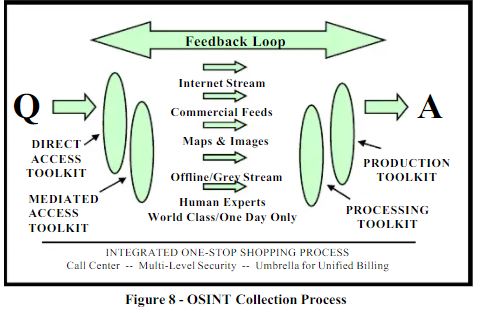
The OSINT process can be divided into the following
| Discovery | Know Who Knows
|
| Discrimination | Know What’s What |
| Distillation | Know What’s Hot |
| Dissemination | Know Who’s Who |
Discuss: If you were to collect information about possible espionage in your home country, following the four D’s, what would your discussion look like?
OSINT sources include everything that can be found online which means that everything that is posted on social media, trading sites, discussion forums can be used in the intelligence process. Remember that open sources are used to complement existing classified intelligence and that they serve to answer a specific intelligence need, which means that OSINT is often used when there is already some kind of prior knowledge.
Open-source intelligence can be searched for in either as:
- Analyst-driven – Based on previous knowledge from the analyst
- Events-driven – In response to time-sensitive relevant events
- Scheduled – Periodic activities to document and update target status
Discuss: Which OSINT do you think goes into each section above? Think about discussion forums, different social media, streaming services, travelling agencies etc.
Check the OSINT cycle image below. How would you explain the OSINT process according to the image and which parts are important to emphasize?
Click here if you wish to read more about OSINT