Curriculum
Module 5 Military Writing in Military Operations
Unit 5.1 - Patrol Reports
0/6

Unit 5.2 - Report Writing
0/6

5.3 The After Action Review
0/6
5.4 Correspondence
0/6
Unit 5.5 - The Intelligence Cycle
0/6
Final Vocabulary Check
0/1

5.2.3 Casualty Reports
Welcome to the lesson about Casualty reports. Watch the lecture by following the link below. If you are unable to watch the link, you will find all the information below.
https://play.fhs.se/media/Casualty+reports/0_scsrfnwvCasualty report – lecture
1. Content and Vocabulary. A casualty can be defined as any person declared deceased, missing, injured, or ill.
- Casualty reports are often oral at the time of the incident, but get written down after the incident.
- Casualty reports also have a function to document and track individuals who become casualties.
- Casualty reports are written to keep NOK (next of kin) informed.
- Casualty reports are often official, but not always.
Two typical acronyms used in casualty reports are:
| KIA | Killed in action |
| WIA | Wounded in action |
You can also use:
| hostile | non-hostile | pending | deceased | casualty status |
| non-military | injured | inflict casualty | case fatality rate | casualty rate |
Exercise A: Read the Casualty Report from the U.S. Department of Defense and then answer the following questions:
-
- How many civilian casualties were registered in Operation Iraqi Freedom?
- How many military personnel were wounded in action in Operation Iraqi freedom in comparison to Operation New Dawn?
- What does the section “pending” mean?
- Choose one of your latest military exercises and write a casualty report based on the example below.
https://www.defense.gov/casualty.pdf

2. Different evacuation requests
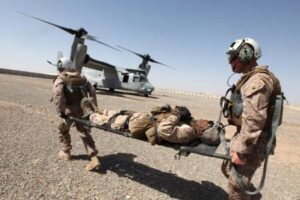
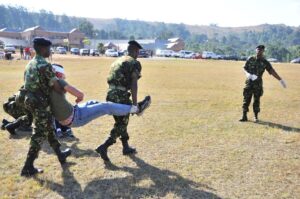
- CASEVAC is the term used when evacuation of casualties from the point of incident (POI) to the closest appropriate military treatment facility (MTF), using the most effective means of transportation takes place. This is often conducted by people on the scene.
- MEDEVAC is the procedure of transporting individuals that have already received prior medical attention and who are in a stable condition at the time of the evacuation.
- STRATEVAC is a national responsibility in a JOA (Joint Operational Area) and is a strategic evacuation.
3. How request evacuation and/or help
The casualty report above displayed a report that is official, however, in the battlefield other casualty reports are made in order to request urgent assistance or evacuation. The protocol for doing this can differ depending on the region; below you can see a common example.
First, an initial report (INIT) is submitted which includes the first medical diagnosis.
 When possible, the 9 liner follows.
Line 1
Location
Line 2
Radio frequency, call sign, suffix
Line 3
Number of patients by precedence
A= Urgent
B= Urgent/Surgical
C= Priority
D= Routine
E= Convenience
Line 4
Special Equipment Needed
A= None
B= Hoist
C= Extrication
D= Ventilator
Line 5
Number of patients
A = Litter
B = Ambulatory
Line 6
Security at pick-up site
N= No enemy troops in area
P= Possible enemy troops in area
E= Enemy troops in area (approach with caution)
X= Enemy troops in areas (armed escort required)
Line 7
Method of marking pick-up site
A= Colored Panels
B= Pyrotechnic Signals
C= Smoke
D= None
E= Other
Line 8
Patient nationality and status
A= Military
B= Civilian
C= Non-Military
D= Non-Civilian
E= Enemy Prisoner of War
Line 9
NBC Contamination
N= Nuclear
B= Biological
C= Chemical
Often a MIST report is included
| M | Mechanism or Medical Complaint |
| I | Injuries or Illness Identified |
| S | Signs and Symptoms |
| T | Treatments |
Exercise B. Take the following quiz on vocabulary addressed above for casualty reports.
Exercise C. Write a 9 liner for the scenario below, and present it orally in class.
You are patrolling the southern areas of H-town when you are suddenly under fire.
1 person is badly wounded in the knee.
1 person has received shot wounds to the shoulder and is bleeding heavily.
You must request evacuation through a 9 liner.
Write your 9 liner and then write a short casualty report.
Exercise C. (optional) If you are viewing this online you can watch this example of a MEDEVAC request.
Example of M1 request – listen and take notes to then complete the quiz
Lesson Materials
