Curriculum
Module 5 Military Writing in Military Operations
Unit 5.1 - Patrol Reports
0/6

Unit 5.2 - Report Writing
0/6

5.3 The After Action Review
0/6
5.4 Correspondence
0/6
Unit 5.5 - The Intelligence Cycle
0/6
Final Vocabulary Check
0/1

5.3.3 AAR
5.3.3 After Action Reviews/Reports
An After Action Review (AAR) is used as an instrument after exercises, battles, and events in order to reflect upon what has happened and to learn what may need to be improved upon for next time. AARs exist in both civilian and military contexts and can be oral or written. Often, a written AAR report is generated and filed to assist in the lessons learned process.
There are no restrictions regarding who conducts AAR, for example, S7/G7/J7 generate evaluations on training and exercises whilst S3/G3/J3 might result in an AAR after a specific incident.
Briefly, AAR serve to
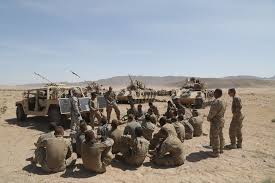
- Guide units towards achieving objectives
- Identify lessons learned
- Increase the skills and capabilities of all participants
In your groups or on your own, reflect on discussions you have had after military exercises.
How were the discussions held?
What different elements were discussed?
Do you think evaluating exercises is important? How do you incorporate lessons learned for future/upcoming exercises?
In all AAR, there are four specific phases where different questions are addressed.
| Phase | Questions to ask |
| Planning | What are the objectives we would like to achieve for this AAR?
What was expected/supposed to happen? Which goals were set? What was the plan? |
| Preparation | What actually occurred/happened? Did the expectations meet with reality? |
| Conduct | What went well and why? Was there a difference between expectations and the actual event, why/why not? |
| Follow-up | What can be learned from this? What can be improved and how? |
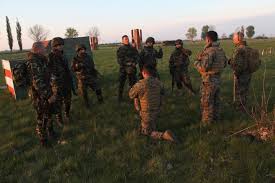
In order to produce an effective AAR, some key elements should be fulfilled.
- Participation by everyone on the team/group/platoon, even Non Governmental Organisations (NGOs) or soldiers can and should be included.
- AAR should be conducted immediately after an event
- Focus on intended (different) training objectives (soldier, leader and unit performance)
- Open-ended questions are used
- Focus on determining strengths and weaknesses
- Link performance to subsequent training
- Maintain order and discipline
- Emphasise that the goal is to achieve Army standards
- Make AARs positive in nature
Can you add anything to the key elements listed above which may be important during an AAR?
The level of formality may also differ during AARs, which means that you must adapt your language to the context. Informal AAR might not be written down and are often conducted in the field with the purpose of improving the results of that group/platoon. Formal AAR are often prepared beforehand, conducted with higher rank officers present, documented and analyzed to improve general guidelines or SOPs.
Since it is very important that everyone shares his or her opinion during the AAR, it is not permitted to
- Lecture
- Critique, criticise or judge performances
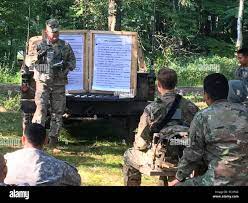
- Embarrass soldiers or leaders
- Compare units
Tasks
1. Watch this AAR video and take notes: AAR to watch (16.36-32.13)
Now answer the following questions by clicking on the link here: AAR quiz