Curriculum
Module 1 Peacekeeping
Unit 1. UN Peacekeeping
0/7


Unit 2. History of peacekeeping
0/7
Unit 3. Types of Peace operations
0/8

Unit 4. Civil-Military Cooperation In Peace Operations
0/8
Unit 5. Tactical communication in Peace operations
0/6
Final Vocabulary Check
0/1
1.5.1. Tactical Communication: Military Alphabet
When communicating and exchanging messages over the radio, basic rules should be followed by all the military partners in order to comply with the NATO standards. Using the same terminology and procedures saves lives.
This unit explains the basic principles of military tactical communication and introduces the military alphabet which is used for the purpose of radio transmissions.
Using proper radio procedures can make the difference in time and security when operating on C2 nets. This unit addresses the proper way to pronounce letters and numbers when sending messages over a radio.
Basic Two-Way Radio Rules:
- The international radio language is English.
- When using a two-way radio you cannot speak and listen at the same time, as you can with a phone.
- Don’t interrupt if you hear other people talking. Wait until their conversation is finished
unless it is an emergency. If it is an emergency, inform the other parties that you have a urgent emergency message. - Do not respond if you aren’t sure the call is for you. Wait until you hear your call sign to respond.
- Never transmit sensitive, confidential, financial or military information. Unless you are certain your conversations are secured with the proper level of encryption for the level of sensitivity, assume your conversations can be heard by others.
- Perform radio checks to ensure your radio is in good working condition.
- Ensure the battery is charged and the power is on.
- Keep the volume high enough to be able to hear calls.
- Regularly make radio checks to make sure everything is working and that you are still in range to receive signals.
- Memorize call signs and locations of persons and radio stations you communicate with regularly.
- In radio communication you are not called by your name. Everybody has their own unique call sign.
- Think before you speak.
- Decide what you are going say and to who it is for.
- Make your conversations as brief, precise, and clear as possible.
- Avoid long and complicated sentences. If your message is long, divide it into separate shorter messages.
- Do not use abbreviations unless they are well understood by your group.
Golden Rules for Radio Communication
- Clarity – Your voice should be clear. Speak a little slower than normal. Speak in a normal tone, do not shout.
- Simplicity – Keep your message simple enough for the listeners to understand.
- Brevity – Be precise and to the point.
- Security – Do not transmit confidential information on a radio unless you know the proper security technology is in place. Remember, frequencies are shared, you do not have exclusive use of the frequency.
Source: Two-Way Radio Etiquette: Basic Rules of Radio Communication – Callmc
1.5.1.1. Pronunciation of numbers
The table outlines the pronunciation of numerals transmitted by radio. Look at the table and listen.
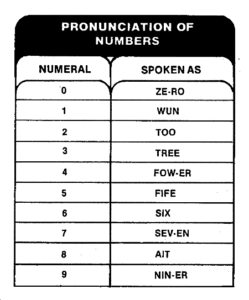
Numbers are transmitted digit by digit.
Special attention should be paid to the pronunciation of 4 as [FOW-ER] and 9 as [NIN-ER]
| NUMBERS | PRONUNCIATION |
| 44 | FOW-ER, FOW-ER |
| 90 | NIN-ER, ZE-RO |
| 136 | WUN, TREE, SIX |
| TIME 1200 | WUN, TOO, ZE-RO, ZE-RO |
| 1748 | WUN, FOW-ER, SEV-EN, AIT |
| 7000 | SEV-EN, TOU-SAND |
| 16000 | WUN, SIX, TOU-SAND |
| 812681 | AIT, WUN, TOO, SIX, AIT, WUN |
Note Any abbreviated words used in the message must be transmitted phonetically, for example, 1st is sent as ONE SIERRA TANGO.
1.5.1.2. Listen to the pronunciation of numbers
1.5.1.3. Listen and write down the numbers you hear
1.5.1.4. Pronunciation of letters
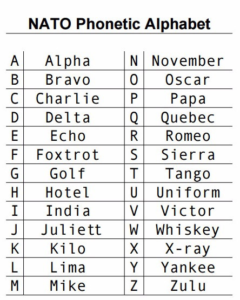
The table below presents the phonetic alphabet for tactical communication and the pronunciation of the letters of the alphabet. Watch the video and listen.
1.5.1.5. Follow the links and do the activities
a/ Practice the alphabet https://quizlet.com/273395/flashcards
b/ Memorize the alphabet https://quizlet.com/273395/learn
c/ Match the letters and numbers https://quizlet.com/273395/match
d/ Practice and play https://quizlet.com/273395/gravity
e/ Take the quiz https://quizlet.com/273395/test
1.5.1.6. Listen and write the call signs you hear 5.1.6. call signs
NB: The answers to 5.1.3. and 5.1.6. are in the attached file
Lesson Materials
