Curriculum
Module 1 Peacekeeping
Unit 1. UN Peacekeeping
0/7
Unit 2. History of peacekeeping
0/7
-
1.2.1. A Short History of United Nations Peacekeeping: Part I
 Preview
-
1.2.2. History of UN Peacekeeping: Part II

-
1.2.3. UN Peacekeeping Changes for 70 Years
-
1.2.4. Vocabulary in context
-
1.2.5. Meet the Expert: PK Experience of an Officer from RNDC (video)
Preview
-
1.2.6. Grammar check: Past Simple Tense
-
1.2.7. Preparing and Presenting a PPP
Preview
Unit 3. Types of Peace operations
0/8

Unit 4. Civil-Military Cooperation In Peace Operations
0/8
Unit 5. Tactical communication in Peace operations
0/6
Final Vocabulary Check
0/1
1.2.1. A Short History of United Nations Peacekeeping: Part I
1.2.1.1. Watch the video and take notes to answer the questions:
- Which is the main document related to peacekeeping?
- What does Chapter 7 permit?
- How are peacekeeping operations sometimes referred to as?
- Who authorizes the deployment of peacekeeping forces?
- Where were peacekeeping forces deployed during the Cold War?
- What was their main function?
- What armaments did the peacekeeping forces have during the Cold War deployments?
- How did the nature of the peacekeeping operations change with the end of the Cold War?
1.2.1.2. Read the text, study the new words and answer the Comprehension questions
PEACEKEEPING is found nowhere in the United Nations Charter. Its invention is often credited to Secretary-General Dag Hammarskjöld (1953-1961), who called it “chapter six and a half” of the Charter—meaning that it is between Chapter VI, which calls for the peaceful resolution of disputes, and Chapter VII, which empowers the Security Council to respond to aggression with military power if negotiations fail.
But some researchers trace the idea of peacekeeping back to the 5th century B.C. when the Greek city-states of the Delian League jointly policed the Aegean Sea. Later, during the Middle Ages, the popes wanted to impose the “Truce of God.” And the 18th century produced a number of utopian writings for preserving peace.
The clearest precedent for present-day peacekeeping, however, is the decision of the League of Nations (an association of countries established in 1919 by the Treaty of Versailles to promote international cooperation and achieve international peace and security which was replaced by the United Nations in 1945) to monitor the referendum that returned the region of Saar to Germany in 1935. Around 3,200 troops from Britain, Italy, Sweden, and the Netherlands, together with a police contingent, were sent to the region under the command of a British general – but wearing their normal uniforms – to preserve law and order while the citizens of Saar voted for their future. This force was described as “a peace force, not a fighting force,” and exercised strict impartiality.
The fact that peacekeeping was not found in the Charter was useful because it gave the Secretary-General and the Security Council flexibility to design operations to respond to the particular circumstances of each crisis. On the other hand, it also allowed the Soviet Union to question the legitimacy of operations that it thought favoured Western interests and to refuse to pay for them. Thus, in 1947 the United Nations assigned military officers to the Special Committee on the Balkans (UNSCOB). It was sent to investigate Communist infiltrations of Greece from neighbouring Balkan states. This operation planted the first seeds of Soviet opposition to the organization’s peacekeeping role. After the Soviet Union vetoed this anti-Communist action in the Security Council, the United States created a precedent which was followed several times in the future, most notably during the Korean War, by seeking authorization from the UN General Assembly, which was then controlled by the West.
The largest of the early true UN peacekeeping operation was the UN Truce Supervision Organization (UNTSO). This force of over 500 military observers was sent to Jerusalem in 1948 to supervise a truce after the first Arab-Israeli war. Israel had been attacked by its neighbors, Egypt, Jordan, Lebanon, and Syria, within hours of its creation. UNTSO was given a flexible mandate and existed until 2018, with its members often redeployed to help with other peacekeeping activities in the region.
Thus, within four-five years of its creation, the UN established a clear procedure for deploying military observer forces in trouble spots around the world, to monitor truces while efforts were made to find a permanent political solution. The UN observers gradually built up a reputation for impartiality, and the Secretary-General slowly established operational control.
Although the observers sent in 1947 to Greece had been told to show “strict impartiality,” US State Department officials were telling Congress in 1949 that the American representatives on all of these early missions were under the “administrative” authority of the United Nations but American “operational” command. But member states increasingly accepted the Secretary-General’s argument that such forces must be independent and impartial to win moral influence with the parties to a dispute, and this required them to take their day-to-day orders from him, with a broad mandate defined by the Security Council. In 1948 the General Assembly agreed to give the Secretary-General a worldwide communications system of his own.
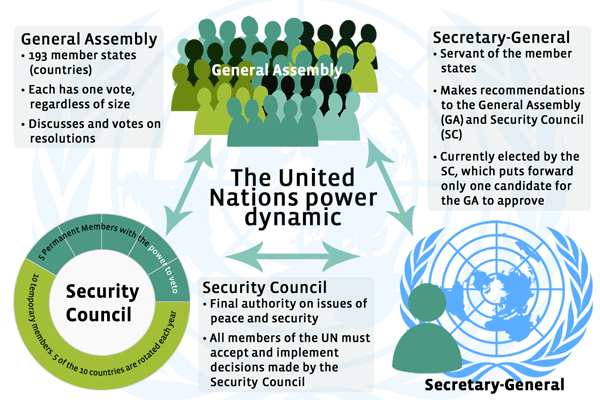
The United States also emerged as a strong supporter of such operations during these early years, agreeing to pay 30 percent of their costs and providing logistic assistance. But Moscow was becoming increasingly alert of the organization’s expanding peacekeeping role and the control of the Secretary-General over these operations, which the Soviets felt served Western interests more than their own by stabilizing troubled parts of the developing world.
Source: Lewis, P. (1992) A Short History of United Nations: Peacekeeping. The Quarterly Journal of Military History. Vol. 5, No. 1. www.historynet.com/short-history-united-nations-peacekeeping
Target vocabulary
United Nations Charter n. a multilateral treaty that serves as the organization’s constitution
Secretary-General of the UN n. The UN Charter designates the secretary-general as the “chief administrative officer” of the UN and allows them to perform “such other functions as are entrusted” by other UN organs. The Charter also empowers the secretary-general to inform the Security Council of “any matter which in his opinion may threaten the maintenance of international peace and security”
negotiation /nɪɡəʊʃɪˈeɪʃ(ə)n/ n. a dialogue between two or more people or parties intended to reach an agreement
truce / truːs/ n. a short interruption in a war or argument, or an agreement to stop fighting for a period of time
precedent /ˈpresɪdənt/ n. an action, situation, or decision that has already happened and can be used as a reason why a similar action or decision should be performed or made
Security Council n. a permanent body of the United Nations seeking to maintain peace and security. It consists of fifteen members, of which five (China, France, the UK, the US, and Russia) are permanent and have the power of veto. The other members are elected for two-year terms
infiltration /ɪnfɪlˈtreɪʃ(ə)n/ n. a technique and process in which a force moves as individuals or small groups over, through or around enemy positions without detection (AAP-6)
veto /ˈviːtəʊ/ v. to refuse to allow something; n. an official power or right to refuse to accept or allow something
deploy /dɪˈplɔɪ/ v. move (troops or equipment) into position for military action
alert /əˈləːt/ adj. quick to notice any unusual and potentially dangerous or difficult situations. AAP-6: n. 1. readiness for action, defence or protection; 2. a warning signal of a real or threatened danger, such as an air attack; 3. the period of time during which troops stand by in response to an alarm; v. to forewarn; to prepare for action.
Comprehension questions
Answer the questions on the Reading text (NB: The answers to the Comprehension questions are in the attached file)
- Who introduced the term “peacekeeping”?
- How was peacekeeping originally called informally?
- When and where was a form of peacekeeping first applied?
- What did the popes want to achieve in the Middle Ages?
- What was the League of Nations?
- What happened in Saar in 1935?
- What was the benefit of not including peacekeeping in the UN Charter?
- Why was UNSCOB assigned?
- How did the Soviet Union respond to UNSCOB?
- What was the purpose of UNTSO? How long did it operate?
- How did the US State Department officials describe the early UN missions to the Congress in 1949?
- What did the General Assembly vote for in 1948?
- What was the US financial contribution to the early peacekeeping?
- How did Moscow feel about the increased control of the Secretary-General?
Lesson Materials
