Curriculum
Module 1 Peacekeeping
Unit 1. UN Peacekeeping
0/7


Unit 2. History of peacekeeping
0/7
Unit 3. Types of Peace operations
0/8

Unit 4. Civil-Military Cooperation In Peace Operations
0/8
Unit 5. Tactical communication in Peace operations
0/6
Final Vocabulary Check
0/1
1.4.1. NATO’s Operations and CIMIC
1.4.1.1. Watch the video of the NATO’s Multinational CIMIC Group and write down the main words which describe CIMIC.
NB! The answer is in the attached file.
1.4.1.2. Read the text and learn the new Target vocabulary words.
Civil-military cooperation (CIMIC) is not a new phenomenon within NATO. NATO’s operations have different and more complex challenges when they are conducted beyond its own domestic borders, on territory, where the civil institutions do not function properly and the infrastructure is damaged. During the early 1990s, NATO realised that any future operation would have to take account of social, political, cultural, religious, economic, environmental and humanitarian factors. As a result of this, NATO needed to establish policies, doctrine, training and physical resources to operate in this environment.
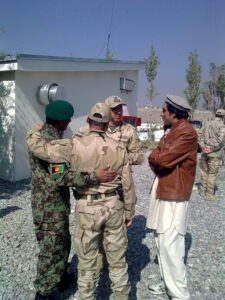
Operations have underlined the requirement to coordinate activities with national and local governments as well as with both international organisations (IOs) and non-governmental organisations (NGOs). The cooperation between military and the civil world is not a new feature. On June 6, 1944, the most important military operation Overlord started bringing 10 000 US and 500 UK Civil Affairs in Normandy. They were responsible to help the sovereign European countries to re-establish the democratic dimension, including commerce and economy, freedom of movement, etc.
In the framework of a military operation conducted by NATO, the spectrum of relations between Alliance forces and non-military actors which include civilian authorities, populations, organisations and agencies, is wide. These relations differ according to the type of activity. Civil-military cooperation is interdependent: military means are requested to help civil authorities, at the same time civil support to the military operation is important.
CIMIC in some form or another is present throughout the complete spectrum of conflict: from combat to peace support operations to assisting with humanitarian and disaster relief.
Definition. Civil-military cooperation is a joint function comprising a set of capabilities integral to supporting the achievement of mission objectives and enabling NATO commands to participate effectively in a broad spectrum of civil-military interaction with different non-military actors.
The aim of CIMIC is to support the mission objectives by establishing and maintaining cooperation with non-military actors within the area of operations. Ideally all actors will work to a common goal. Where this is not possible, CIMIC will ensure that activities to support each plan are harmonized. Thus, negative impacts on own operations, on non-military operations and on the civil environment are avoided. This will minimize interference or unintended conflict between different actors.
Application. CIMIC is applicable to all types of NATO operations. The application of CIMIC depends on the type of operation, the civil environment, and the relationship with non-military actors.
Source: AJP-3.19 Allied Joint Doctrine for Civil-Military Cooperation, Ed. 1, November 2018. NATO Standardization Office.
1.4.1.3. Watch the video which explains the main aspects of CIMIC. While watching, write down the 3 core functions of CIMIC.
NB! The answer is in the attached file.
Target vocabulary
- sovereign /ˈsə-v(ə-)rən/ adj. a sovereign state in international law is a political entity that is represented by one centralized government that has sovereignty over a geographic area.
- framework /ˈfreimˌwərk/ n. the ideas, information, and principles that form the structure of an organisation or plan
- spectrum /ˈspektrəm/ n. 1. a band of colours, as seen in a rainbow; 2. a wide range
- interdependent /ˌintərdiˈpendənt/ adj. (of two or more people or things) dependent on each other.
- means /miːnz/ n. an action or system by which a result is achieved; a method
- joint /dʒɔɪnt/ adj. belonging to or shared between two or more people
- comprising /kəmˈprʌɪzɪŋ/ v. consisting of; made up of
- capability /keɪpəˈbɪlɪti/ n. the ability to do something, capacity, powers; the number of weapons, soldiers, etc. a country has to fight a war
- interference /ɪntəˈfɪər(ə)ns/ n. 1. obstruction; 2. a jumbling of radio signals
Practice the new words with the Dialogue Cards below:
Lesson Materials
